So you’re standing in Marrakech, dreaming of golden dunes, camel treks, and a night under a sky full of stars — but you’re not sure how to actually get there? You’re not alone. This is one of the most common questions we get from travelers planning their Morocco trip, and honestly, it makes sense. The Sahara Desert isn’t exactly next door to Marrakech, and there are several ways to make the journey, each with its own pros, cons, and price tag.
In this guide, we’ll walk you through every single option for getting from Marrakech to the Sahara Desert, how long it takes, what it costs, and which route makes the most sense depending on your travel style and time budget.
📍 First Things First: Which “Sahara Desert” Are We Talking About?
Before we dive into transportation, it’s important to clarify something that confuses a lot of first-time visitors: there isn’t just one desert location near Marrakech.
The two main desert destinations reachable from Marrakech are:
1. Erg Chebbi (Merzouga)
This is the most famous and most visited Sahara destination in Morocco. Located near the town of Merzouga, close to the Algerian border, Erg Chebbi features Morocco’s tallest dunes (up to 150 meters), making it the postcard-perfect Sahara experience.
- Distance from Marrakech: approximately 560 km
- Travel time: 8-9 hours by road (usually split over 2 days)
2. Erg Chigaga (Zagora)
A more remote, less touristy desert area near M’Hamid, reached via Zagora. Fewer crowds, more authentic feel, but requires additional 4×4 transport to reach the actual dunes.
- Distance from Marrakech: approximately 450 km to M’Hamid, then 4×4 needed
- Travel time: 6-7 hours by road + 1-2 hours by 4×4 to reach the dunes
💡 Quick tip: If it’s your first time and you want the “classic” Sahara postcard experience with easy access, Merzouga (Erg Chebbi) is almost always the better choice. If you’re looking for something wilder and less crowded, Erg Chigaga is worth considering — but it requires more effort to reach.
🚗 Option 1: Organized Desert Tour (Most Popular Choice)
This is, by far, the most common and most recommended way for tourists to get from Marrakech to the Sahara Desert — and for good reason.
How it works
You book a multi-day tour (usually 2, 3, or 4 days) that includes everything: transportation, driver, stops along the way, accommodation, and the desert camp experience itself.
What’s typically included
- Private or shared 4×4/minivan transportation
- Experienced driver-guide
- Stops at scenic points (Atlas Mountains, Ait Ben Haddou, Todra Gorge, Dades Valley)
- Overnight stays in guesthouses (riads/kasbahs)
- Camel trek into the dunes
- One night in a desert camp (standard or luxury)
- Traditional Berber dinner and breakfast
- Drop-off in Marrakech, Fes, or another city
Popular route: The Classic 3-Day Desert Tour
Day 1: Marrakech → Atlas Mountains → Ait Ben Haddou → Dades Valley
Day 2: Dades Valley → Todra Gorge → Merzouga → Camel trek → Desert camp
Day 3: Sunrise in the desert → Return to Marrakech
Why this is the best option for most travelers
- No stress about logistics — everything is handled for you
- Scenic stops along the way you’d miss if you just flew or drove directly
- Local expertise — drivers know the road conditions, best photo spots, and hidden gems
- Social experience — great for solo travelers who want to meet others
- Better value — combining transport + accommodation + activities is usually cheaper than doing it all separately
Price range
| Tour Type | Price per person (2 people sharing) |
|---|---|
| Budget shared group tour | $80 – $150 |
| Private tour (standard camp) | $150 – $280 |
| Private tour (luxury camp) | $280 – $500+ |
🐪 Ready to book your Sahara adventure? Asmaa Travel offers carefully designed desert tours from Marrakech, combining comfort, authentic experiences, and unforgettable memories in the dunes. Check out our available Sahara circuits and let us handle every detail of your journey.
✈️ Option 2: Fly to Errachidia or Ouarzazate, Then Drive
If you’re short on time, flying part of the way and driving the rest is a smart compromise.
How it works
- Fly from Marrakech (or Casablanca) to Errachidia or Ouarzazate airport
- From there, arrange a private transfer or join a shorter tour to Merzouga
Flight details
- Marrakech to Ouarzazate: No direct commercial flights currently operate on this short route regularly — check Royal Air Maroc schedules as they change seasonally
- Casablanca to Errachidia: Occasional flights with Royal Air Maroc (subject to schedule)
From airport to desert
- Ouarzazate to Merzouga: approximately 4 hours by car
- Errachidia to Merzouga: approximately 2 hours by car
Is this option worth it?
Honestly, for most travelers, it’s not the best choice. Here’s why:
- Flights are infrequent and schedules change often
- You miss the incredible scenery along the classic overland route (Atlas Mountains, kasbahs, gorges)
- You still need ground transportation on both ends
- It’s often more expensive than a direct desert tour when you add up flight + transfer costs
This option only makes sense if you have very limited time (2-3 days total in Morocco) and want to prioritize desert time over the journey itself.
🚌 Option 3: Public Bus (Budget Option)
For backpackers and budget travelers, public buses are a viable — if slower — option.
Bus companies
- CTM (most reliable, comfortable, air-conditioned)
- Supratours (also reliable, government-affiliated)
Typical route
Marrakech → Ouarzazate → Zagora or Rissani/Erfoud (closest bus stops to Merzouga)
Journey details
- Marrakech to Ouarzazate: 4-5 hours (~100-150 MAD)
- Ouarzazate to Erfoud/Rissani: additional 4-5 hours (~120-150 MAD)
- From Rissani/Erfoud to Merzouga: taxi or arranged pickup needed (30-45 minutes, ~150-200 MAD for the taxi)
Pros and cons
Pros:
- Very budget-friendly
- Good way to meet locals
- CTM buses are surprisingly comfortable
Cons:
- Long journey, often requiring an overnight stop
- No scenic stops along the way
- You’ll need to arrange your own desert camp and camel trek separately once you arrive
- Schedule coordination can be tricky
💡 Reality check: While technically possible, taking public buses to the Sahara is time-consuming and requires a lot of independent planning. It’s best suited for experienced backpackers with flexible schedules and a strong sense of adventure.
🚕 Option 4: Private Driver / Grand Taxi (Custom & Flexible)
If you want full control over your schedule and stops, hiring a private driver is an excellent middle-ground option.
How it works
You hire a private car with driver (not necessarily a full guided tour) to take you directly to Merzouga, with stops wherever you want along the way.
Advantages
- Complete flexibility on timing and stops
- Can be done in one long day or split over two days at your own pace
- Comfortable for families or small groups
- No fixed itinerary — stop for photos whenever you like
Price range
- One-way private transfer: $120 – $200 depending on vehicle type and stops included
- With overnight stop and sightseeing: $200 – $350 for the full journey
Where to book
You can arrange this through your riad, a local travel agency, or platforms specializing in Morocco transportation. Just make sure the driver is licensed and the vehicle is properly insured.
🚗 Option 5: Self-Drive (Rental Car)
For the more adventurous and independent travelers, renting a car and driving yourself is possible — but requires careful consideration.
What you need to know
- Road conditions: The main route (via Ouarzazate) is well-paved and in good condition
- Mountain driving: The Tizi n’Tichka pass through the Atlas Mountains involves winding roads at high altitude — not for nervous drivers
- Distance: 560 km total, roughly 8-9 hours of actual driving time
- Fuel stops: Available but sometimes spaced out — always keep your tank at least half full
Car rental costs
- Economy car: $30-50/day
- SUV/4×4: $60-100/day
Important considerations
- You’ll need an International Driving Permit alongside your national license
- Night driving is not recommended due to unlit roads, animals crossing, and unclear road markings in rural areas
- Once near Merzouga, you cannot drive directly into the dunes — you’ll need to park at a guesthouse and continue by camel or 4×4
⚠️ Word of caution: Self-driving to the Sahara is doable, but it eliminates the cultural insights and hassle-free experience that come with organized tours. It’s best for confident drivers who specifically want independence and don’t mind handling logistics themselves.
🗺️ Comparing All Options: Which One Is Right for You?
| Option | Time | Cost (per person) | Best For |
|---|---|---|---|
| Organized tour | 2-3 days | $80-500 | Most travelers, first-timers, solo travelers |
| Flight + transfer | 1-2 days | $150-300 | Time-limited travelers |
| Public bus | 2+ days | $30-60 | Backpackers, budget travelers |
| Private driver | 1-2 days | $120-350 | Families, flexible schedules |
| Self-drive | 2 days | $80-200 (car rental) | Independent, confident drivers |
🏜️ What to Expect Once You Arrive in the Desert
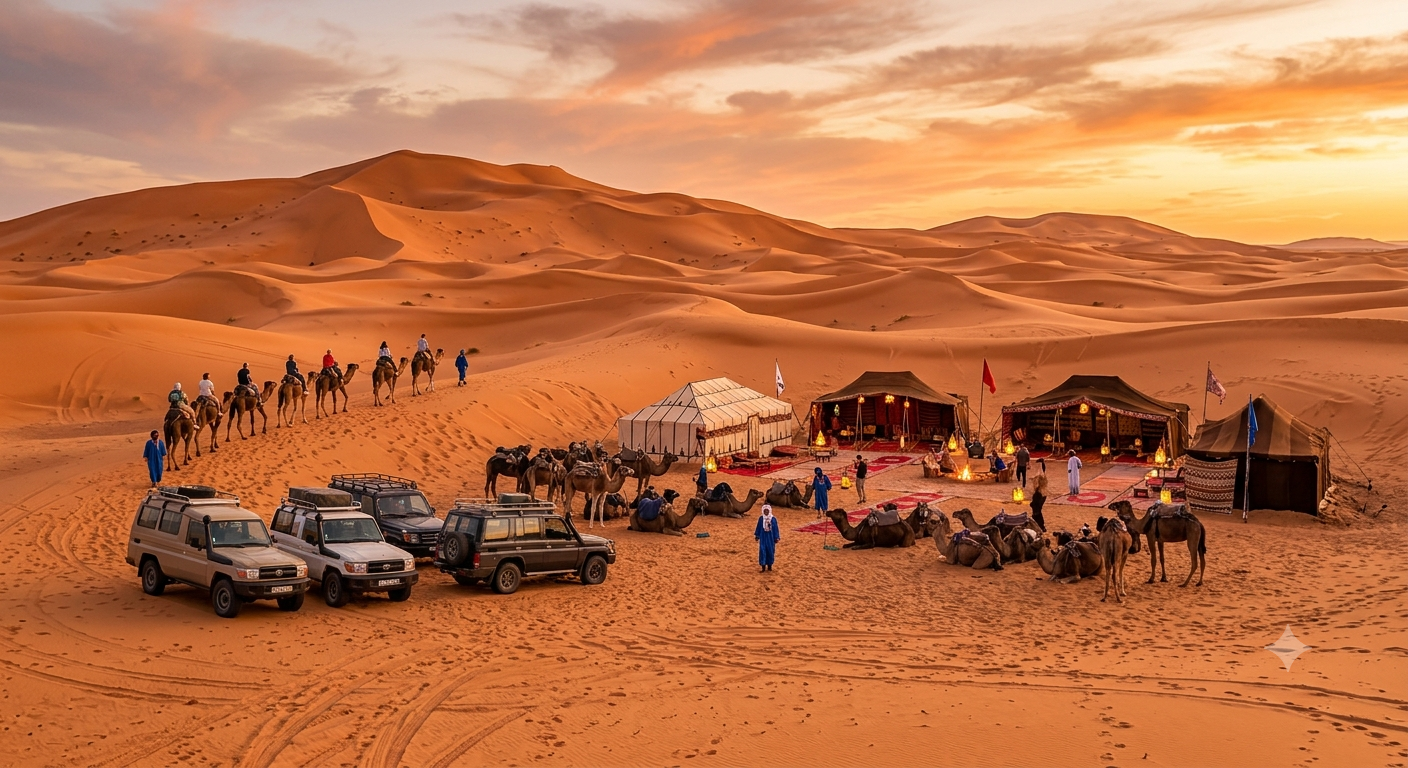
Regardless of which transportation option you choose, here’s what typically happens once you reach the Merzouga area:
- Arrival at a guesthouse/kasbah on the edge of the dunes (this is where vehicles stop)
- Camel trek into the desert (typically 45 minutes to 1 hour at sunset)
- Overnight stay in a desert camp (ranging from basic Berber tents to luxury glamping setups)
- Traditional dinner around a campfire, often with live Berber music
- Sunrise viewing from the dunes (a truly magical experience)
- Camel ride back and return journey begins
📅 Best Time to Travel from Marrakech to the Sahara
The road journey and desert experience vary significantly depending on the season:
Spring (March-May) & Autumn (September-November): Ideal
Comfortable daytime temperatures, cool desert nights perfect for camping, clear skies for stargazing.
Summer (June-August): Extremely Hot
Daytime temperatures in the desert can exceed 45°C (113°F). If you travel during this period, plan activities early morning or evening, and stay well-hydrated.
Winter (December-February): Cold Nights
Daytime temperatures are pleasant, but desert nights can drop below freezing. Make sure your tour includes warm blankets, or bring proper layers.
🎒 Practical Tips for the Journey
- Pack layers — temperatures vary drastically between day and night in the desert
- Bring a scarf or turban — useful for sand protection, especially during camel treks
- Download offline maps — cell signal becomes spotty outside major towns
- Bring cash — smaller towns and rest stops along the route often don’t accept cards
- Motion sickness remedy — the mountain roads have many curves; bring medication if you’re prone to car sickness
- Camera with extra batteries — you’ll want to capture the incredible desert sunsets and starry skies
- Comfortable walking shoes — for exploring kasbahs and short desert walks
🛣️ The Scenic Route: What You’ll See Along the Way
One of the biggest advantages of the overland journey (versus flying) is the scenery you’ll pass through:
- Tizi n’Tichka Pass — dramatic mountain pass through the High Atlas (2,260m elevation)
- Ait Ben Haddou — UNESCO World Heritage kasbah, famous as a filming location for Game of Thrones and Gladiator
- Ouarzazate — known as “the Hollywood of Morocco” due to its film studios
- Dades Valley — dramatic rock formations and the famous “Valley of Roses”
- Todra Gorge — massive canyon walls reaching up to 300 meters high
- Rose-colored kasbahs and traditional Berber villages along the route
This journey isn’t just about reaching a destination — it’s an experience in itself, showcasing Morocco’s incredible geographic diversity from mountains to desert.
❓ FAQ – Getting from Marrakech to the Sahara Desert
1. How far is the Sahara Desert from Marrakech?
The most popular desert destination, Merzouga (Erg Chebbi), is approximately 560 km from Marrakech, requiring about 8-9 hours of driving time, typically split over two days with an overnight stop.
2. What is the best way to get from Marrakech to the Sahara Desert?
For most travelers, an organized multi-day desert tour is the best option. It includes transportation, accommodation, meals, and activities, while also allowing you to see incredible scenery along the way that you’d miss by flying.
3. Can I do a day trip from Marrakech to the Sahara Desert?
Technically no — not to the real dunes. The distance is too far for a comfortable single-day round trip. Most tours are minimum 2 days/1 night, with 3-day tours being the most popular and comfortable option.
4. Is there a direct flight from Marrakech to Merzouga?
No, there is no airport in Merzouga itself. The closest airports are in Ouarzazate or Errachidia, and flight schedules to these destinations can be limited and change seasonally. From either airport, you’ll still need 2-4 hours of ground transportation to reach Merzouga.
5. How much does a desert tour from Marrakech cost?
Prices vary based on group size and accommodation level:
- Budget shared tours: $80-150 per person
- Private tours with standard camps: $150-280 per person
- Luxury private tours: $280-500+ per person
6. Is the road from Marrakech to the Sahara safe?
Yes, the main road via Ouarzazate is well-maintained and considered safe. The Tizi n’Tichka mountain pass involves winding roads, so if you’re prone to motion sickness, come prepared. Driving with an experienced local driver is recommended, especially for first-time visitors.
7. What should I pack for a trip from Marrakech to the Sahara?
Essential items include: layered clothing (it’s cold at night, hot during the day), a scarf or turban for sand protection, comfortable walking shoes, sunscreen, a reusable water bottle, and a camera for the incredible desert scenery and starry skies.
8. Can I visit Erg Chigaga instead of Merzouga?
Yes! Erg Chigaga (near M’Hamid/Zagora) is a less touristy alternative to Merzouga, offering a more remote desert experience. However, it requires additional 4×4 transportation to reach the actual dunes, making it slightly more complex logistically but rewarding for those seeking fewer crowds.
9. What’s included in a typical 3-day desert tour from Marrakech?
Most 3-day tours include: private or shared transportation, an experienced driver-guide, stops at scenic locations (Ait Ben Haddou, Dades Valley, Todra Gorge), overnight accommodations, a camel trek into the dunes, one night in a desert camp with dinner and breakfast, and return transportation to Marrakech (or drop-off in Fes).
10. Do I need a 4×4 vehicle to reach the Sahara Desert?
For the main route to Merzouga, a standard car or minivan is sufficient since the road is paved. However, if you’re heading to more remote areas like Erg Chigaga, a 4×4 vehicle is required for the final stretch through sandy terrain.
🌟 Ready to Experience the Sahara Desert?
Getting from Marrakech to the Sahara Desert is more than just a logistical challenge — it’s the beginning of one of the most unforgettable adventures Morocco has to offer. Whether you choose an organized tour, a private driver, or a more independent route, the journey through the Atlas Mountains, ancient kasbahs, and dramatic valleys sets the stage for the magic that awaits in the dunes.
At Asmaa Travel, we specialize in creating unforgettable Sahara Desert experiences from Marrakech. Our tours combine comfort, authentic Berber culture, and stunning natural beauty, ensuring you experience the desert exactly as it should be experienced.
👉 Explore our Sahara Desert tours from Marrakech and let us take care of every detail, from pickup to camel trek to sunrise over the dunes.
📩 Contact us today to book your Sahara adventure and create memories that will last a lifetime.