Planning to check off some genuinely world-class historical sites during your Morocco trip? You’re in luck. Morocco holds an impressive collection of UNESCO World Heritage Sites, each telling a different chapter of the country’s incredibly layered history — from Roman ruins and Portuguese fortresses to imperial medinas and coastal trading posts.
In this guide, we’re covering Morocco’s UNESCO World Heritage Sites in detail, plus one additional site currently on UNESCO’s Tentative List that’s absolutely worth adding to your radar. Whether you’re a history enthusiast planning a dedicated cultural itinerary or simply want to make sure you don’t miss anything essential, this list has you covered.
📋 Quick Note on Morocco’s UNESCO Status
Before diving in, let’s be transparent about something: Morocco officially has 9 inscribed UNESCO World Heritage Sites. For this guide, we’re covering all 9 in detail, plus featuring one exceptional site currently on Morocco’s UNESCO Tentative List (meaning it’s been nominated and is under consideration for future inscription) as a genuine bonus worth knowing about.
This gives you a complete, accurate picture of Morocco’s most significant heritage sites — both officially recognized and soon-to-be recognized.
🏛️ 1. Medina of Fez
Inscribed: 1981 | Location: Fez
If you visit only one UNESCO site in Morocco, make it this one. The Medina of Fez (Fes el Bali) is widely considered the world’s largest car-free urban area and one of the best-preserved medieval Islamic cities on Earth.
What makes it exceptional:
- Home to the University of Al Quaraouiyine, founded in 859 CE and recognized by UNESCO and Guinness World Records as the oldest continuously operating university in the world
- Over 9,000 narrow streets and alleyways forming an intricate medieval urban labyrinth
- The famous Chouara Tannery, where leather has been dyed using traditional methods for centuries
- Stunning examples of Marinid-era architecture, including intricately carved gates and madrasas
Why it earned UNESCO recognition: The medina represents an outstanding example of a medieval Islamic city that has remained remarkably intact, both in its urban fabric and its living traditions, since the 9th century.
🕌 2. Medina of Marrakesh
Inscribed: 1985 | Location: Marrakesh
Morocco’s most visited city center earned its UNESCO status for good reason. The Medina of Marrakesh represents centuries of Almoravid, Almohad, and Saadian architectural achievement.
What makes it exceptional:
- The Koutoubia Mosque, whose minaret has served as the architectural template for other significant structures, including the Giralda in Seville
- Bahia Palace, showcasing exceptional 19th-century craftsmanship with intricate stucco work and painted cedar ceilings
- Ben Youssef Madrasa, once one of the largest Islamic colleges in North Africa
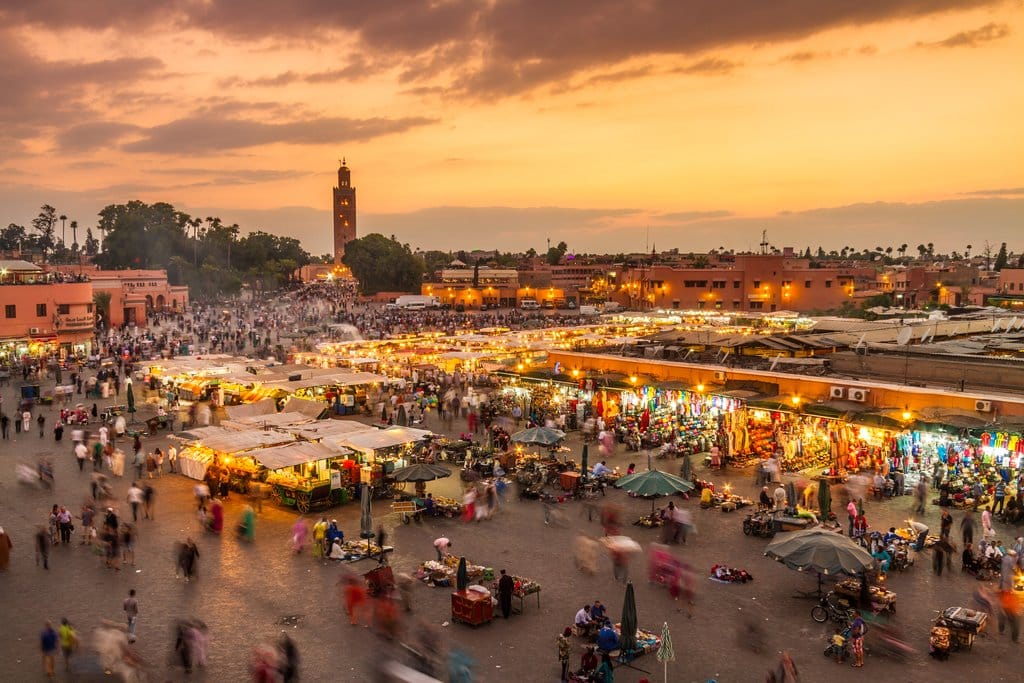
- Jemaa el-Fna square, itself separately recognized by UNESCO as a Masterpiece of Oral and Intangible Heritage of Humanity for its living tradition of storytellers, musicians, and performers
Why it earned UNESCO recognition: The medina represents an exceptional testimony to Berber, Arab, and Andalusian civilization, with its urban structure and monuments reflecting centuries of continuous development.
🏰 3. Ksar of Ait-Ben-Haddou
Inscribed: 1987 | Location: Near Ouarzazate
Perhaps Morocco’s most photographed UNESCO site, this fortified village (ksar) has appeared in countless films and TV productions, including Gladiator and Game of Thrones.
What makes it exceptional:
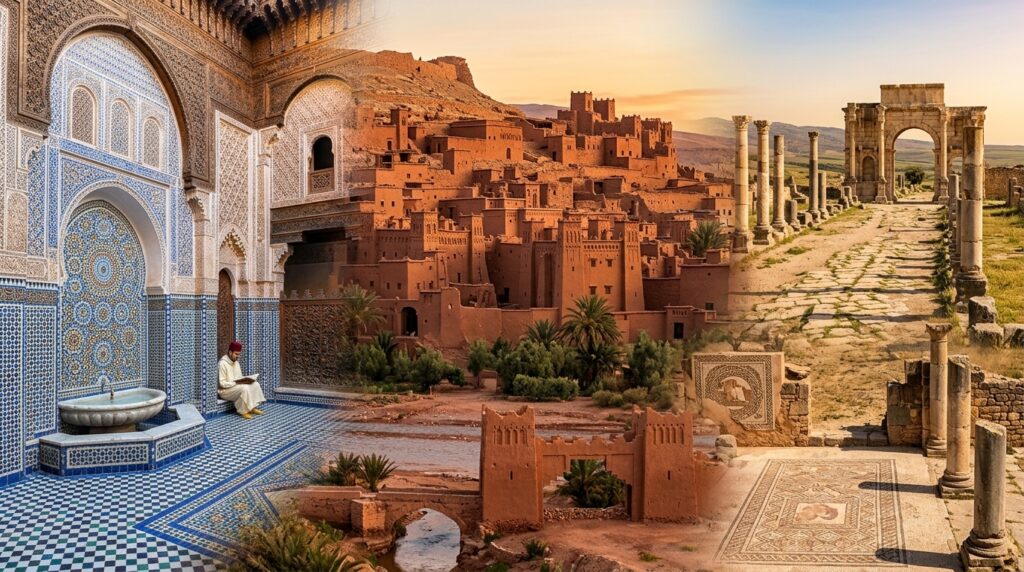
- A striking example of traditional earthen clay architecture, with reddish-brown kasbahs rising dramatically against the surrounding landscape
- Historically served as a significant stop along the trans-Saharan caravan trade route between Marrakech and the Sahara
- Despite significant tourism, a small number of families still live within the ancient structure, maintaining its status as a living heritage site
- The dramatic setting against the Atlas Mountains foothills makes it one of Morocco’s most visually striking locations
Why it earned UNESCO recognition: The ksar exemplifies traditional Saharan earthen architecture and represents an outstanding example of the type of fortified settlement historically found along pre-Saharan trade routes.
If you’re planning a Sahara Desert trip, Ait-Ben-Haddou is almost always included as a stop along the way, making it easy to combine with broader desert tours heading toward Merzouga.
🕌 4. Historic City of Meknes
Inscribed: 1996 | Location: Meknes
Often overshadowed by Fez and Marrakech, Meknes deserves significantly more attention than it typically receives from international visitors.
What makes it exceptional:
- Built as the imperial capital under Sultan Moulay Ismail in the 17th century, with grandiose architectural ambitions rivaling European palaces of the same era
- The massive Bab Mansour gate, considered one of the most beautiful monumental gates in North Africa
- Extensive underground granaries and stables (Heri es-Souani) originally designed to house thousands of horses
- A distinctly Spanish-Moorish architectural influence blended with Islamic design principles
Why it earned UNESCO recognition: Meknes represents a harmonious blend of Islamic and European architectural styles from this particular historical period, showcasing an ambitious 17th-century vision of imperial urban planning.
🏛️ 5. Archaeological Site of Volubilis
Inscribed: 1997 | Location: Near Meknes
This is Morocco’s most significant Roman archaeological site, and honestly, it surprises many visitors who don’t expect such well-preserved Roman ruins in North Africa.
What makes it exceptional:
- Remarkably preserved mosaic floors depicting mythological scenes, still visible in their original locations
- The Triumphal Arch, built to honor Emperor Caracalla, remains an impressive standing structure
- Ruins of a basilica, forum, and numerous wealthy Roman villas offering insight into provincial Roman life
- A UNESCO buffer zone protecting the surrounding agricultural landscape that has remained largely unchanged for centuries
Why it earned UNESCO recognition: Volubilis represents an exceptionally well-preserved example of a Roman colonial town on the empire’s furthest frontier, with mosaics of genuinely outstanding artistic quality.
Volubilis pairs naturally with a visit to Meknes and nearby Moulay Idriss, and many travelers combine both sites in a single day through organized excursions from Fez or Meknes.
🏘️ 6. Medina of Tétouan
Inscribed: 1997 | Location: Tétouan
Located in northern Morocco, Tétouan’s medina offers a distinctly different architectural character shaped heavily by Andalusian refugees.
What makes it exceptional:
- Strong Andalusian architectural influence, brought by Muslims and Jews who fled Spain following the Reconquista
- Notably well-preserved artisan traditions, particularly in leatherwork, embroidery, and traditional crafts
- A more intimate, less touristy medina experience compared to Fez or Marrakech
- Distinctive white-washed buildings reflecting Mediterranean architectural sensibilities
Why it earned UNESCO recognition: Tétouan represents one of the most complete examples of the type of town founded by Andalusian refugees and exemplifies the strong Hispano-Moorish cultural exchange of that historical period.
🌊 7. Medina of Essaouira (formerly Mogador)
Inscribed: 2001 | Location: Essaouira
This coastal gem earned its UNESCO status for a very different reason than Morocco’s inland imperial cities — its exceptional example of European military architecture adapted to a North African context.
What makes it exceptional:
- Designed in the late 18th century by French engineer Théodore Cornut, blending European fortification principles with local building traditions
- The Skala de la Ville sea bastion, lined with historic cannons, offers dramatic ocean views
- A distinctive blue-and-white color scheme throughout the medina
- Historical significance as an international trading port connecting Morocco to European and sub-Saharan trade networks
Why it earned UNESCO recognition: Essaouira represents an outstanding example of a late 18th-century fortified town, exemplifying the interchange of European and Moroccan architectural traditions in a trading port context.
Given its distinct coastal character and windsurfing reputation, Essaouira makes an excellent addition to any Morocco itinerary, whether through a day trip from Marrakech or a longer coastal stay.
🏰 8. Portuguese City of Mazagan (El Jadida)
Inscribed: 2004 | Location: El Jadida
One of Morocco’s lesser-known UNESCO sites, Mazagan offers a genuinely unique glimpse into Portuguese colonial history in North Africa.
What makes it exceptional:
- Built by Portuguese settlers in the early 16th century as a fortified trading post
- The remarkably preserved Portuguese Cistern, an underground water reservoir with a striking reflective pool effect
- Massive fortification walls demonstrating Renaissance-era military engineering
- One of the earliest examples of European colonial settlement architecture in West Africa
Why it earned UNESCO recognition: Mazagan represents an outstanding example of the interchange of influences between European and Moroccan cultures, particularly notable as one of the earliest Portuguese settlements in this region prior to Portugal’s decline as a colonial trading power.
🏛️ 9. Rabat, Modern Capital and Historic City
Inscribed: 2012 | Location: Rabat
Morocco’s most recently inscribed UNESCO site is also unique in that it recognizes both ancient heritage and 20th-century urban planning simultaneously.
What makes it exceptional:
- Combines the historic Almohad-era city walls and the incomplete Hassan Tower with French colonial-era urban planning from the early 20th century
- The Mausoleum of Mohammed V, an architectural masterpiece honoring Morocco’s royal family
- A rare UNESCO recognition of successful integration between historic Arab-Muslim heritage and modern colonial-era city design
- Kasbah of the Udayas, offering stunning ocean views and distinctive blue-and-white residential architecture
Why it earned UNESCO recognition: Rabat represents an exceptional example of urban planning that successfully bridges historic Islamic heritage with early 20th-century modernist principles, creating a genuinely harmonious modern capital city.
🎁 Bonus: Aire du Grand Toubkal (Tentative List)
Status: UNESCO Tentative List (submitted 2011) | Location: High Atlas Mountains
While not yet an officially inscribed UNESCO World Heritage Site, this stunning High Atlas region surrounding Mount Toubkal — North Africa’s highest peak — is currently on Morocco’s Tentative List, meaning it’s been formally nominated and is under consideration for future inscription.
What makes it worth visiting now:
- Home to Mount Toubkal (4,167m), the highest peak in North Africa
- Exceptional biodiversity, including species found nowhere else in the world
- Traditional Berber villages maintaining agricultural practices largely unchanged for generations
- Some of the best trekking opportunities in North Africa, with routes suitable for various experience levels
Why we’re including it: Getting to experience a future UNESCO site before its official inscription offers a genuinely special feeling — you’re witnessing recognized natural and cultural significance before it becomes a major tourist draw. Trekking activities in this region are readily available for travelers wanting to explore this landscape now.
🗺️ How to Plan a UNESCO-Focused Morocco Itinerary
If you’re genuinely interested in covering multiple UNESCO sites during your trip, here’s how they naturally cluster geographically.
Northern Cluster (3-4 days)
Tétouan → Chefchaouen (non-UNESCO but worth including) → Tangier area
Imperial Cities Cluster (5-7 days)
Rabat → Meknes → Volubilis → Fez
This cluster works particularly well since these cities sit relatively close together, making it feasible to visit all four UNESCO-recognized locations within a single week-long circuit.
Southern/Desert Cluster (4-6 days)
Marrakech → Ait-Ben-Haddou → (continuing toward Sahara Desert)
Coastal Addition (1-2 days)
Essaouira (easily added to a Marrakech-based itinerary) or El Jadida/Mazagan (closer to Casablanca)
The Complete UNESCO Circuit (12-14 days)
For genuinely dedicated heritage travelers wanting to cover all 9 official sites plus the Toubkal region, a comprehensive 12-14 day circuit combining all clusters above becomes very achievable, particularly with organized tours handling the logistics between destinations.
📸 Photography Tips for Morocco’s UNESCO Sites
Given how visually distinctive each site is, here are some practical tips for capturing them well:
- Fez and Marrakech medinas: Early morning (before 9 AM) offers the best light and fewest crowds in narrow alleyways
- Ait-Ben-Haddou: Golden hour (both sunrise and sunset) creates dramatic shadows on the earthen architecture
- Volubilis: Midday actually works well here since the mosaics are best photographed with direct overhead light
- Essaouira: Late afternoon light on the Skala ramparts creates beautiful warm tones against the blue Atlantic
- Rabat: Sunset at the Kasbah of the Udayas offers stunning views over the ocean and river mouth
🎒 Practical Tips for Visiting Morocco’s UNESCO Sites
- Licensed guides are often required for entry to certain monuments within these sites, particularly in Fez and Marrakech — this isn’t optional bureaucracy but a genuine legal requirement in many locations
- Entrance fees vary significantly — some sites like the medinas themselves are free to wander, while specific monuments (Bahia Palace, Volubilis) charge separate entrance fees
- Comfortable walking shoes are essential — medina exploration involves significant walking on uneven, sometimes cobbled surfaces
- Respect photography restrictions — some religious sites within these locations restrict photography, particularly active mosques
- Consider combining sites through organized excursions — particularly for sites requiring longer travel like Volubilis or Ait-Ben-Haddou, joining private excursions simplifies logistics considerably compared to independent travel
❓ FAQ – UNESCO Sites in Morocco
1. How many UNESCO World Heritage Sites does Morocco have?
Morocco officially has 9 inscribed UNESCO World Heritage Sites: the Medinas of Fez, Marrakesh, Tétouan, and Essaouira; the Ksar of Ait-Ben-Haddou; the Historic City of Meknes; the Archaeological Site of Volubilis; the Portuguese City of Mazagan; and Rabat’s modern capital and historic city.
2. Which is the oldest UNESCO site in Morocco?
The Medina of Fez, inscribed in 1981, was Morocco’s first UNESCO World Heritage Site. It’s also home to the world’s oldest continuously operating university, founded in 859 CE.
3. Can I visit all of Morocco’s UNESCO sites in one trip?
Yes, though it requires a well-planned itinerary of approximately 12-14 days to comfortably cover all 9 official sites plus the bonus Toubkal region, given the geographic distances between the northern, central, and southern locations.
4. Is Chefchaouen a UNESCO World Heritage Site?
No, despite its popularity and stunning blue-washed medina, Chefchaouen is not currently a UNESCO World Heritage Site. It remains an incredibly popular destination regardless, but it’s not part of Morocco’s official UNESCO list.
5. Which UNESCO site in Morocco is best for first-time visitors?
The Medina of Marrakesh and Ksar of Ait-Ben-Haddou are typically the most accessible and impactful for first-time visitors, both being commonly included in standard Morocco itineraries and offering immediately striking visual experiences.
6. Do I need a guide to visit Morocco’s UNESCO sites?
For certain monuments within the medinas (like specific palaces or religious schools), licensed guides are legally required for group access. For general medina wandering, a guide isn’t mandatory but is often recommended, particularly in Fez, given how easy it is to get disoriented in the labyrinthine streets.
7. Is Volubilis worth visiting if I’ve already seen Roman ruins elsewhere?
Yes, genuinely. Volubilis offers exceptionally preserved mosaics still in their original locations, along with a unique North African provincial Roman context that differs meaningfully from Roman sites in Europe or the Middle East.
8. What is Morocco’s newest UNESCO World Heritage Site?
Rabat, Modern Capital and Historic City, inscribed in 2012, is currently Morocco’s most recently recognized UNESCO World Heritage Site.
9. Are there additional Moroccan sites being considered for UNESCO status?
Yes, Morocco has several sites on UNESCO’s Tentative List, including the Aire du Grand Toubkal in the High Atlas Mountains, meaning these locations have been formally nominated and may receive official inscription in future years.
10. Which UNESCO site pairs best with a Sahara Desert trip?
Ksar of Ait-Ben-Haddou is almost always included as a stop on the route between Marrakech and Merzouga, making it a natural and easy addition to any Sahara Desert-focused itinerary.
🌟 Ready to Explore Morocco’s UNESCO Heritage?
From the medieval alleyways of Fez to the Roman mosaics of Volubilis and the dramatic earthen walls of Ait-Ben-Haddou, Morocco’s UNESCO World Heritage Sites offer a genuinely remarkable journey through centuries of layered history, culture, and architectural achievement. Whether you’re drawn to living medina traditions, ancient archaeological wonders, or colonial-era fortifications, these sites deliver experiences that go well beyond typical tourist photo opportunities.
At Asmaa Travel, we help travelers experience Morocco’s most significant heritage sites through thoughtfully designed itineraries that balance must-see monuments with authentic cultural immersion.
👉 Start planning your UNESCO heritage journey:
- Explore our comprehensive tours covering multiple UNESCO sites
- Browse our excursions for day-trip options to sites like Volubilis
- Consider private excursions for a personalized heritage-focused itinerary
- Discover unique activities to complement your cultural exploration
📩 Contact us today to design your perfect Morocco UNESCO heritage itinerary for 2026.